Frequently Asked Questions
Answers for families considering scoliosis surgery. If your question is not here, call or email the practice.
Understanding Adolescent Idiopathic Scoliosis (AIS)
What is Adolescent Idiopathic Scoliosis?
Adolescent Idiopathic Scoliosis (AIS) is an abnormal lateral curvature of the spine accompanied by vertebral rotation, occurring in teenagers between the ages of 10 and 18. “Idiopathic” means there is no single known cause, though it is strongly linked to genetic and growth-related factors.
How do I know if my teenager needs surgery instead of bracing or physical therapy?
Non-surgical treatments like bracing or physical therapy (e.g., Schroth method) are designed to prevent curve progression while a child is still growing. Surgery is typically considered when the spinal curve (Cobb angle) exceeds 45° to 50°, or if the curve continues to worsen rapidly despite consistent bracing. Curves past this threshold tend to progress into adulthood if uncorrected which leads to worsening posture and possible effects on circulation and breathing.
Will my child still retain flexibility after spinal fusion surgery?
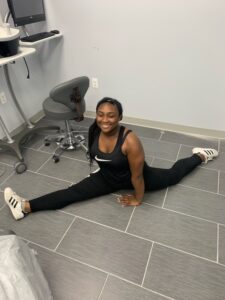
Spinal fusion holds the curved segment of the spine in a corrected, stable position. While the fused portion becomes stationary, Dr. Sarwahi uses motion-sparing techniques whenever possible to leave lower lumbar segments unfused. Teenagers typically adapt remarkably well and maintain excellent overall mobility for sports, dance, and everyday activity.
Recovery & Post-Op Expectations
How long is the hospital stay after minimally invasive scoliosis surgery?
With minimally invasive techniques, most patients are discharged within 2 to 3 days after surgery, compared to 5 to 7 days for traditional open fusion.
When can my teenager return to school and sports?
- School: Most teens feel ready to return to school (part-time or full-time) within 2 to 3 weeks.
- Light Activity & Walking: Encouraged immediately after surgery.
- Non-contact Sports & Athletics: Usually cleared between 6 to 12 weeks, depending on individual healing and fusion progress.
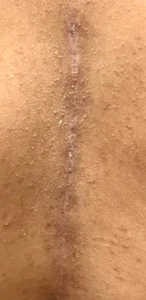
What kind of scarring should we expect?
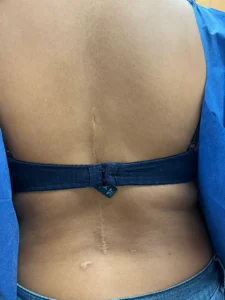
We use the assistance of a plastic surgeon and scarring involves one continuous line down the back. Our scars are significantly smaller, fade over time, and are much less prominent cosmetically.
Scheduling & Consultations
Do you offer virtual second opinions for out-of-town or international families?
Yes. Dr. Sarwahi offers free remote consultations and virtual second opinions for families evaluating surgical options or seeking guidance on complex scoliosis cases.
How do we prepare for an initial consultation?
Please bring or upload any recent full-spine X-rays (EOS or digital DICOM files on a CD/flash drive), prior medical records, and reports regarding previous treatments (such as bracing logs or MRI scans if performed). If you do not have any imaging we can help you obtain it after our consultation.
Is surgery covered by Insurance?
Yes. We will work to obtain coverage for all major commercial insurances (Aetna, BCBS, Cigna, UHC, Oxford, 1199).
Take the next step toward your child’s spine health
Whether you are seeking a first opinion or exploring minimally invasive options for a progressive curve, Dr. Sarwahi and his team are here to guide your family with compassionate, expert care.